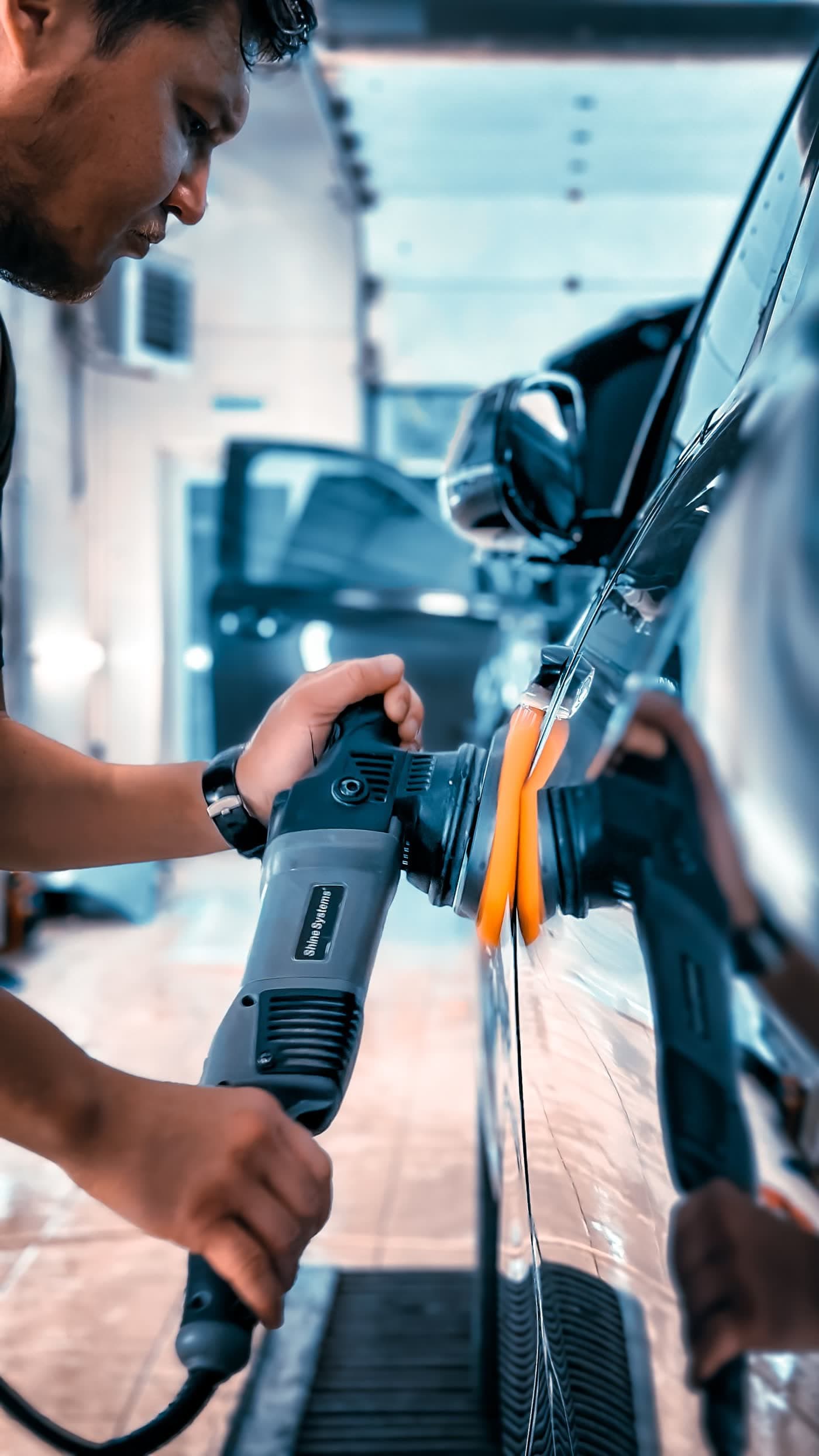
> TL;DR: A great paint correction shop measures your paint before touching it, works under proper inspection lighting, and corrects only what your clear coat can safely give up. Avoid flat-rate "detail specials" that promise correction in an hour — real single-stage correction takes 4–8 hours, multi-stage 8–16. Ask about paint depth gauges, lighting, and warranty before you book.
Why Choosing the Right Correction Shop Matters More Than Any Other Detailing Service
Most detailing is forgiving — a mediocre wash just means you wash again next week. Paint correction is different: it permanently removes material from your clear coat. Done well, it restores a mirror finish that lasts for years. Done badly — too aggressive, wrong pads, no measurement — it thins your clear coat, burns through edges, or leaves holograms that are worse than the swirls you started with.
That's why the shop matters. The machine is the same in everyone's hands; the judgment isn't. This guide walks through exactly how to tell a genuine paint correction specialist from a detailer who bought a dual-action polisher and calls it correction.
The 7 Questions That Separate a Real Correction Shop From the Rest
1. "Do you measure my paint depth before correcting?"
The single most important question. Clear coat is typically only 40–60 microns thick, and safe correction removes a few microns at a time. A serious shop uses a paint depth gauge (PTG) on every panel to confirm there's enough clear coat to work with — especially on used cars that may have been corrected or repainted before. If a shop doesn't own or use one, walk away.
2. "What lighting do you inspect under?"
Standard shop fluorescents hide most defects. Real correction happens under high-intensity LED swirl-finder lights that reveal swirls, holograms, and buffer trails invisible in normal light. If a shop can't show you the before/after under proper lighting, they can't prove they corrected anything.
3. "Is this single-stage or multi-stage — and why?"
A good shop assesses *your* paint and recommends the appropriate depth, not a one-size package. Light swirls may lift in a single stage; deep defects need compound-then-polish. Be wary of a shop that quotes "correction" without inspecting the car first — the honest answer is "we'll know after we assess it under lights."
4. "How long will it take?"
Time is the giveaway. Genuine correction is slow, panel-by-panel work:
| Correction Level | Realistic Time |
|---|---|
| Single-stage (light defects) | 4–8 hours |
| Multi-stage (moderate–heavy) | 8–16 hours |
| Heavy correction / wet sanding | 16+ hours |
If someone promises "full correction" in an hour, they're describing a glaze or filler — products that temporarily hide swirls with oils that wash out in a few weeks. That's not correction.
5. "Do you do a final IPA (or panel wipe) inspection?"
Compounds and polishes contain oils that mask remaining defects. A meticulous shop wipes each panel with an isopropyl alcohol solution to strip those oils and reveal the *true* corrected finish before calling it done. This is how you know the result is real removal, not temporary filling.
6. "What's your plan for the edges and trim?"
Panel edges, badges, and plastic trim are where inexperienced polishers burn through or sling compound. A pro masks these off and hand-works tight areas. Ask how they protect vulnerable zones — the answer tells you how careful they are.
7. "What happens after correction — do you recommend protection?"
Correction removes defects but doesn't protect the paint from re-marring. A good shop will recommend locking in the result with a ceramic coating or paint protection film, and will explain proper wash technique. A shop that corrects and sends you back to the same automatic car wash that swirled the paint isn't thinking about your result.
Red Flags to Avoid
🚩 Flat-rate "correction" with no inspection — real quotes depend on your paint's condition
🚩 "Correction" completed in under 2 hours — that's a glaze, not correction
🚩 No paint depth gauge — they're guessing how much clear coat they're removing
🚩 No before/after under proper lighting — they can't prove the work
🚩 Vague about products or process — a pro can explain their compound/polish steps
🚩 Pressure to bundle without assessing the car — good shops assess first, quote second
What Genuine Paint Correction Costs in Toronto (2026)
Honest correction is priced by your paint's condition and your vehicle's size — not a flat coupon rate:
| Service | Compact | Mid-Size Sedan / SUV | Full-Size SUV / Truck |
|---|---|---|---|
| Single-Stage Correction | $300–$450 | $400–$600 | $500–$750 |
| Multi-Stage Correction | $600–$900 | $800–$1,200 | $1,000–$1,500+ |
| Correction + Ceramic Coating | $900–$1,800 | $1,200–$2,400 | $1,500–$3,000+ |
If a quote is dramatically below these ranges, ask what's actually being done — it's often a one-pass glaze rather than measured correction. For the full process breakdown, see our paint correction guide.
Why Toronto Drivers Choose Advanced Vehicle Guard
At our Etobicoke studio, every correction starts with a paint depth measurement and an LED inspection, panel by panel. We dial our polishers to your specific paint hardness, remove only what's needed to preserve your factory clear coat, and finish with an IPA wipe-down so what you see is real, permanent correction — not oils that wash away. We'll also recommend the right protection to keep the result looking flawless, whether that's a ceramic coating or PPF on high-impact zones.
We serve clients across the GTA — Toronto, Mississauga, Vaughan, Markham, and beyond.
---
Frequently Asked Questions
How do I know if my car even needs correction?
Look at the paint under direct sunlight at a 45-degree angle. Circular swirl patterns, cobweb scratches, or a hazy finish instead of clear reflections mean you have correction-worthy defects.
Is paint correction permanent?
Yes — you're physically removing material, so the defects are gone for good. The finish stays flawless until new swirls are introduced by improper washing. A ceramic coating and proper wash technique preserve the result.
Can any detailer do paint correction?
Many offer it; fewer do it properly. The difference is measurement, lighting, technique, and patience. Use the seven questions above to tell them apart.
Do you serve Oakville and Burlington?
Yes — we serve the full GTA including Oakville, Burlington, Etobicoke, and surrounding areas.
---
📍 Advanced Vehicle Guard | 222 Evans Ave., Etobicoke, ON M8Z 1J8 | (647) 874-7318
Book Paint Correction · Paint Correction Process Guide · Learn About Ceramic Coating